Call Us: +6012-590 0783
Email Us: [email protected]
Follow Us: 


Call Us: +6012-590 0783
Email Us: [email protected]
Follow Us:


When planning a fencing project, many property owners, contractors, and developers face an important decision: should they use precast concrete fence posts or construct a wall using ready mixed concrete?
Both options rely on concrete as a durable construction material, but they differ significantly in terms of installation method, project timeline, cost, maintenance requirements, and long-term flexibility. Choosing the right solution depends on the purpose of the fence, site conditions, budget, and desired appearance.
For projects throughout Selangor, understanding the strengths and limitations of each system can help ensure a more efficient and cost-effective investment.
Before comparing them, it is important to understand how each solution works.
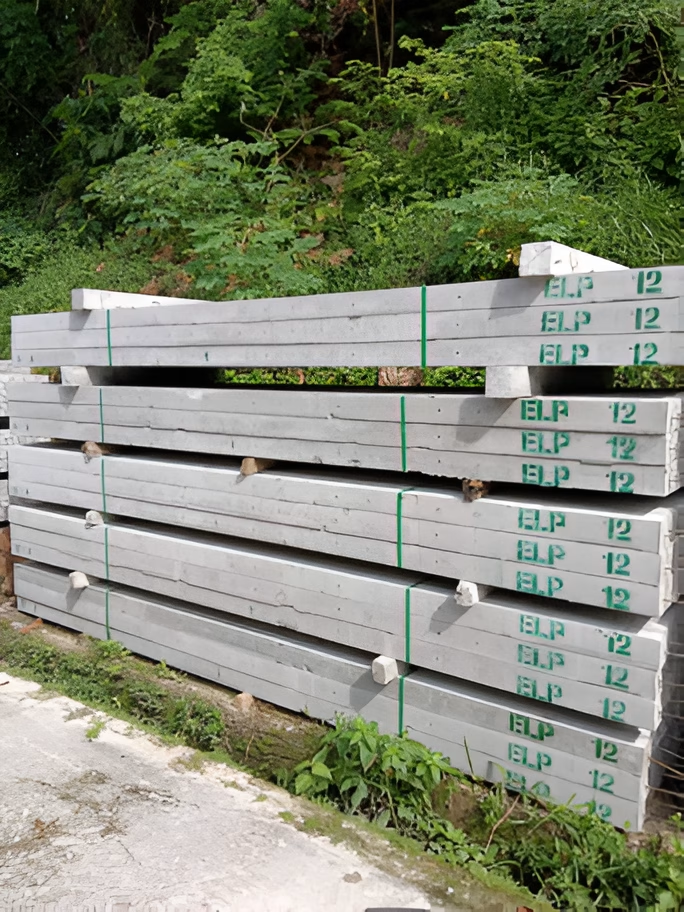
Concrete fence posts are precast components manufactured in a controlled production environment before being transported to the project site. If you are sourcing materials locally, choosing a high-quality concrete fence post Selangor supplier ensures your structural components are built to handle regional soil and weather conditions. They are commonly used together with concrete panels, chain link fencing, barbed wire fencing, agricultural fencing, and industrial perimeter fencing.
Ready mixed concrete is produced in a batching plant and delivered to construction sites in a freshly mixed state for immediate placement. It is commonly used for cast-in-place retaining walls, boundary walls, foundations, and structural elements. Industry standards such as ASTM C94 and MS 523 specify quality requirements for ready mixed concrete Malaysia manufacturing, production, and delivery.
| Factor | Concrete Fence Posts | Ready Mixed Concrete Walls |
|---|---|---|
| Manufacturing Method | Precast in factory | Cast on-site |
| Installation Speed | Fast | Slower |
| Labour Requirement | Lower | Higher |
| Site Preparation | Minimal | Extensive |
| Formwork Needed | No | Yes |
| Curing Time on Site | Minimal | Required |
| Future Modifications | Easier | More difficult |
| Initial Cost | Often lower for fencing applications | Typically higher |
| Suitable for Large Boundary Fences | Excellent | Good but more labour intensive |
For many projects, speed is a critical factor.
Precast concrete products are manufactured off-site while site preparation can occur simultaneously. This parallel workflow helps reduce overall project duration and minimizes weather-related delays. Industry organizations such as the Precast/Prestressed Concrete Institute (PCI) identify accelerated construction as one of the major advantages of precast concrete systems.
With concrete fence posts, installation typically involves:
In contrast, constructing a concrete wall using ready mixed concrete generally requires:
For long perimeter fencing projects such as factories, warehouses, plantations, and development sites, the time savings offered by precast fence systems can be substantial.
Quality consistency is another important consideration.
Precast concrete components are manufactured in controlled factory environments where materials, curing conditions, and dimensional tolerances can be closely monitored. PCI-certified facilities highlight quality control as one of the key advantages of precast construction.
Ready mixed concrete also benefits from controlled batching processes. Modern batching plants use carefully measured mix designs to deliver concrete that meets specified performance requirements. Standards such as ASTM C94 alongside MS 523 provide requirements for ready mixed concrete production and delivery.
However, the final quality of a cast-in-place wall can still be affected by:
This is why many fencing applications favour precast solutions where quality can be more consistently controlled before installation.
Cost comparisons should consider more than just material prices.
While every project is different, concrete fence posts often provide savings through:
A ready mixed concrete wall may be justified when structural requirements demand a continuous reinforced wall. However, for standard boundary fencing, industrial perimeters, agricultural land, and commercial compounds, precast fence systems often provide a more economical solution.
Both systems can offer excellent durability when properly designed and installed.
Concrete is naturally resistant to weather exposure, fire, and corrosion compared to many alternative fencing materials. In Selangor’s hot, humid tropical climate which characterized by sudden heavy downpours and high evaporation rates, material resilience is key. Industry sources note that precast concrete products are designed for long service life and high durability under varying environmental conditions.
For fencing applications, concrete fence posts provide several practical advantages:
A properly constructed ready mixed concrete wall can also last for decades, but maintenance requirements may increase if cracks develop due to settlement, shrinkage, or inadequate curing practices.
Concrete Fence Posts Are Usually Better For:
Ready Mixed Concrete Walls Are Usually Better For:
The Malaysian construction industry continues to adopt more precast solutions due to their efficiency, consistency, and ability to reduce construction timelines.
Precast concrete products are manufactured in controlled environments and delivered ready for installation, helping contractors improve productivity while maintaining quality standards. These advantages have contributed to the growing popularity of precast concrete Malaysia solutions across industrial, infrastructure, and commercial projects.
There is no single solution that fits every project. The right choice depends on your project’s objectives, budget, timeline, and structural requirements.
For most perimeter fencing applications in Selangor, concrete fence posts offer clear advantages in terms of installation speed, cost efficiency, and ease of maintenance. Their precast manufacturing process allows for consistent quality while reducing on-site construction activities.
Meanwhile, ready mixed concrete walls remain an excellent option when projects require structural strength, continuous wall construction, or specialised engineering requirements.
By evaluating both solutions early in the planning stage, property owners and contractors can select a fencing system that delivers the best balance of performance, durability, and long-term value.
Whether you need high-quality precast solutions like Concrete Posts (Tiang Concrete 4×4) and Fence Posts (Tiang Pagar 3×3) for a commercial perimeter in Klang, or ready mixed concrete for structural foundations in Semenyih, Ezi Maju is your trusted building materials partner in Selangor and KL.
Contact our team today to secure a quote tailored to your project timeline!
The decision depends largely on the purpose of the boundary. For perimeter demarcation, industrial fencing, agricultural land, and security fencing that incorporates mesh or panels, concrete fence posts are often the more practical and cost-effective choice. A cast concrete wall is generally more suitable when the structure must provide retaining support, noise reduction, privacy, or enhanced security.
It is also important to consider site conditions. On uneven or expansive soil, segmented fence systems supported by concrete posts may accommodate minor ground movement better than continuous concrete walls, which can be more susceptible to visible cracking if movement occurs.
Yes. Properly manufactured precast concrete products are designed to withstand long-term exposure to sunlight, rain, humidity, and temperature fluctuations. Concrete is naturally resistant to corrosion, rot, and termite attack, making it particularly suitable for Malaysia’s tropical climate.
Durability depends on factors such as concrete strength, curing quality, reinforcement design, and installation practices. Precast components produced in controlled factory environments often achieve more consistent quality than site-cast elements because manufacturing conditions can be closely monitored throughout the production process.
Many property owners focus only on material prices, but the total project cost is usually influenced by several additional factors, including:
For example, a project with difficult site access may require additional machinery or labour, increasing overall costs regardless of whether precast fence posts or ready mixed concrete walls are selected. Obtaining a detailed site assessment before procurement helps prevent unexpected expenses later in the project.
In many cases, yes. One advantage of fence systems that use precast concrete posts is that sections can often be extended, repaired, or modified more easily than a continuous cast-in-place wall.
This flexibility can be valuable for factories, warehouses, agricultural properties, and development sites that may require future expansion. Property owners should still verify local authority requirements, setback regulations, and utility locations before carrying out any modifications to an existing boundary structure.
Beyond pricing, buyers should evaluate the supplier’s manufacturing standards, product consistency, delivery capabilities, and project experience. Important considerations include:
Requesting product samples, technical specifications, or previous project references can help verify that the materials are suitable for your intended application and expected service life.
Contact us today for high-quality materials and reliable solutions tailored to your construction needs.